


REGINA CARTER | |
Regina Carter (1963 -- ) Acclaimed jazz violinist and recording artist, recipient of a 2006 MacArthur Fellowship "Jazz is a feeling!" -- Regina Carter | 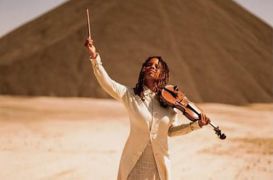  |
Hear Regina's group, Reverse Thread, play Artistya Regina Carter, violin; Yacouba Sissoko, koro (West African harp); Will Holshouser, accordion; Chris Lightcap, bass; Alvester Garnett, drums & percussion. I heard them live and they are fantastic! | |
1963 -- 1980 A PASSION FOR MUSIC | 1963 prices and events |
Regina was born in Detroit, MI, the youngest child of Dan Carter, an auto worker, and Grace Williamson Carter, an elementary school teacher. Her musical talent became evident at age two when she interrupted an older brother’s piano lesson to pick out the notes to a song he was learning. She later said, “I had a passion for [music] at a very young age.” [1] At four she began Suzuki violin lessons, learning to play by ear first and only later learning to read music. She credits her improvisational skills to the freedom this allowed. “No rules have been set up and you haven’t been taught to be afraid of anything.” [2] At the Detroit Community Music School, she and her two brothers took lessons in piano and dance—Regina studied tap and ballet—and listened to a wide variety of music—classical, Motown, R&B, funk, Greek, and Latin—both at home and at concerts. [1] During high school, she played with the Detroit Civic Symphony. Her goal was to become a classical violin soloist. But when she was 16, a friend took her to hear jazz violinist Stephane Grappelli, an experience that changed her goals. “Seeing how much fun he was having—the passion and freedom in the music—I wanted to have that same experience.” [3] At a master class with classical violinist Yehudi Menuhin, her violin teacher said, without enthusiasm, that Regina wanted to play jazz. “[Menuhin] picked up his violin,” Regina said “and played some kind of jazz lick, as if to say, ‘It’s OK!’” [4] Classically-trained jazz violinist Jean-Luc Ponty became her idol. | Bread: .21/loaf Milk: 1.04/gal Car: $2,300 Gas: $ 0.31/gal House: $19,300 Income: $6,998/year President John F. Kennedy Top Books: Silent Spring, Rachel Carson; The Guns of August, Barbara Tuchman Top songs: He's So Fine, Chiffons; Fingertips (Pt 2) Little Stevie Wonder Alabama Governor George Wallace pledges: “segregation now, segregation tomorrow and segregation forever.” Civil Rights leader Medgar Evers murdered in Jackson, MS. 200,000 march for racial equality in Washington, DC. Dr. Martin Luther King, Jr. gives his “I have a dream” speech. Four little girls die when a black Baptist church is firebombed in Birmingham, AL. November 23: President JFK assassinated; Lee Harvey Oswald arrested. Lyndon Johnson sworn in as president. Millions of TV viewers see Jack Ruby kill Lee Harvey Oswald. |
1981 -- 1998 Jazz studies, Germany, then New York | 1981 news and events |
Upon graduating from Detroit’s prestigious Cass Technical High school, Regina enrolled in the New England Conservatory of Music in Boston, where she discovered other jazz violinists like Stuff Smith. After concentrating on classical music the first year, she decided to focus on jazz, but NEC had no jazz violin teacher. A year later, she enrolled at Oakland University in Michigan. She studied jazz composition and improvisation, but her understanding of jazz had just begun. “Unlike classical music,” she said, “you can’t study books one, two and three and then you’ve got it. You have to study the culture of the music as well.” [5] Her big band director advised her to listen to horn players and learn how to breathe. Learning solos by jazz greats like Charlie Parker and Clark Terry was a daunting experience, but she persevered until she could sing them and translate it to her violin. [5] After earning a B.A. in performance from Oakland University in 1985, she taught violin in the Detroit public school for a year. Then she moved to Germany. “It seemed like I had been in school forever and I was just tired,” she said. “I needed to travel and be around different people.” [6] For two years she sat in at jazz clubs, played in a German-American funk band and enjoyed being on her own, while continuing to study Charlie Parker solos. [6] | US population: 230.5 million Inflation is 14 percent. Mortgage rates: 17 %. CDC publishs first report on the AIDS epidemic. US Supreme Court rules that states can require parental notification when teenage girls seek abortions. Reagan appoints the first woman to the US Supreme Court, Arizona judge Sandra Day O’Connor The wedding of Prince Charles and Lady Diana is watched worldwide on TV. There are more divorces (1,210,000) in the U.S. than ever before. President Reagan shot by John Hinkley, Jr., in Washington, DC. He recovers. Pope John Paul II shot in St. Peter’s Square. He recovers. Egyptian President Anwar Sadat, 62, assassinated in Cairo. |
Back in Detroit in 1987 she began studying with trumpeter Marcus Belgrave. An Oakland University faculty member and mentor to young musicians, he had played and recorded with Ray Charles, Max Roach, Charles Mingus and Ella Fitzgerald. That year she joined Straight Ahead, a Detroit based all-female jazz quintet, playing electric violin with them at the Montreux Jazz Festival and on two recordings (1992, 1993). [7] In 1993 she moved to New York and joined the String Trio of New York. She also worked with Dolly Parton, Billy Joel and Mary J. Blige, did radio and TV work, and sat in on jam sessions at the Blue Note and other clubs. [5] She released two recordings, Regina Carter (1995) and Something for Grace (1997), which were largely ignored by jazz critics and producers. | 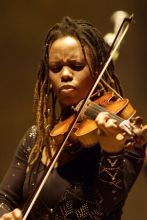 |
In 1998 she played the Newport Jazz Festival and joined jazz singer Cassandra Wilson on her tribute tour to Miles Davis, “Travelin’ Miles.” More attention came when she toured and recorded with Wynton Marsalis on his Pulitzer Prize winning opera, Blood on the Fields. In 1999 Verve Records released her critically acclaimed album Rhythms of the Heart; Time Magazine named it one of the year’s top 10 records. Of her CD, Motor City Moments (2000), Matt Abramovitz wrote on NPR’s website: “... the album is overflowing with talent, spirit, and beauty.” In 2001, Ray Brown invited her to play on his 75th birthday concert. Watch it here LADY BE GOOD | |
2000 -- 2006 A new century brings two prestigious honors |
On December 31, 2001, Regina was the first jazz musician and the first African-American chosen to play the 250-year old Guarneri violin owned by Nicolo Paganini. Dubbed “The Cannon” because of its huge sound, the violin is insured for $40 million and is kept in Genoa, Italy, played there only once a year by a virtuoso chosen by a committee. Photo at right: Regina plays "The Cannon" Some critics felt the violin should not be played by a jazz violinist, but the audience was on its feet throughout the concert, which included jazz | 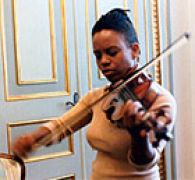 |
standards made famous by Billie Holliday, Ella Fitzgerald, Duke Ellington and Thelonius Monk, pieces by J.S. Bach, as well as her own compositions. In 2003 she returned to Genoa to use the violin on her 2003 recording, Paganini: After a Dream. Critic Sonya Murray called the CD “an album that anyone would find absolutely beautiful.” [8]
To counter those who consider jazz inferior to classical music, Regina cites examples in which classical musicians were expected to improvise. Down Beat Magazine named her Best Jazz Violinist for five straight years. To those who believe the violin is only for classical music, she says: “It’s just an instrument. It doesn’t come with a set of instructions that say, ‘For Classical Use Only.’” [4]
Music education is another passion. “I don’t want to just play at audiences, but educate them as well.” While on tour, she does workshops for Suzuki violin teachers and music fans. For a time she was artist in residence at San Francisco Performances, teaching music to disadvantaged children and playing at Bay Area community centers and churches. [9] | |
In 2004 she married Alvester Garnett, who plays percussion in her band, and they settled in New Jersey. Sadly, in 2005, Regina's mother died. Grace Carter had nurtured Regina’s early talent, inspired her with pride and told her to seek her personal best in all she did, and, most importantly, to give the world her soul-stirring music. Regina dedicated her next CD to her mother: I’ll Be Seeing You, a collection of songs from the 1920s to the 1940 that Grace Carter enjoyed in her youth. [9] | |
In 2006 Regina was awarded a prestigious MacArthur Foundation Fellowship, which included a grant of $500,000. Citing the overlooked potential of the jazz violin for its lyric, melodic and percussive potential, the Foundation deemed her music “swing with a soulful sound,” citing her ability to tap into a broad musical vocabulary and weave new sound tapestries.
“She captivates her audience with the passion and spirit of adventure intrinsic to her approach to music. Through her artistry on an instrument defined predominantly by the classical tradition, Regina Carter is pioneering new possibilities for the violin and for jazz.” [9] | |
Having played for her mother during her illness, Regina immediately knew what she wanted to do with part of the MacArthur grant. “I want to go back to school for music therapy. I want to help other people, whether it’s children, the elderly, or people in hospices.” [10] | 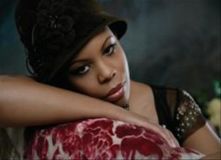 |
In 2014, Regina released her first album for Sony Masterworks. Titled Southern Comfort, the album connects two of her previous albums. A Sentimental Journey (2006) a collection of her mother's favorite jazz standards, and Reverse Thread (2010), which celebrates the tradition of African music reimagined for a small jazz group. Visit her website to see her tour dates. REGINA CARTER WEBSITE | 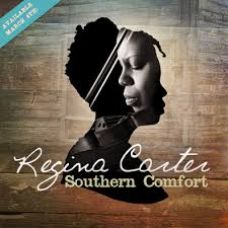 |
COMMENTARY Regina's talent, determination and capacity for hard work were evident at an early age. She had a passion for music and music education, and the support and encouragment of her family.
OBSTACLES: Regina encountered resistence from some who believed the violin should be used for classical playing only. Her selection to play the Paganini violin in Genoa was criticized by some, until they heard her play. As for gender discrimination, she only recalls one incident, early in her career. She believes women represent a different aesthetic than men: "We are nurturers. We bring a different energy, totally." Having said this, she adds, "I like it when there's a mixture of both [genders]. [6] ROLE MODELS and MENTORS: Regina's role models were mostly male: classical violinists Itzhak Perlman and Yehudi Menuin; jazz violinists Stephane Grappelli, Jean-Luc Ponty and Stuff Smith, and jazz giants like saxophonists Charlie Parker and Ben Webster, and trumpeter Clark Terry. Her mother was her earliest mentor; another was Detroit trumpeter-jazz instructor Marcus Belgrave. |
DISCOGRAPHY | |
Listen to Regina Carter on YouTube Regina Carter partial discography Solo albums I’ll Be Seeing You: A Sentimental Journey, 2006 Paganini: After a Dream, 2003 Freefall (with Kenny Barron), 2001 Motor City Moments, 2000 Rhythms of the Heart, 1998 Something for Grace, 1997 Regina Carter, 1995 A Sentimental Journey, 2006 Reverse Thread, 2010 Southern Comfort, 2014 | Regina Carter On the records of others: Flame, 1997 Steve Turre, 1997 Loopin’ the Cool, 1996 (Mark Helias) Dreamland, 1996 It’s All Good, 1995 (Antonio Hart) Faith Evans, 1995 I’m Glad There is You: A tribute to Carmen McRae, 1994 (Vanessa Rubin) Fun, 1994 (Daniel Johnston) My Life, 1994 (Mary J. Blige) Body and Soul, 1993 (Straight Ahead) Intermobility, 1993 (String Trio of NY) Look Straight Ahead, 1992 (Straight Ahead) |
SOURCES: REGINA CARTER 1. "Motor City Maverick," Susan M. Barbieri, www.stringsmagazine.com 2. International Musician, cover story, May 2001 3. Current Biography (2003), quoting The Berkshire Eagle, 4/19/2001 4. CB, quoting The Raleigh (NC) News and Observer-2/8/2002 5. “Regina Carter: Improvising a Life in Jazz,” Terry Perkins 6. Jazzwomen, Conversations with Twenty-one Musicians, Wayne Enstice and Janice Stockhouse, 2004 7. “Taking a Bow at Newport,” Bob Blumenthal, Boston Globe, 3/15/1998 8. Atlanta Journal-Constitution, 4/27/2003 9. “Regina Carter,” Verve Records profile, www.vervemusicgroup.com 10. MacArthur Foundation website: 2006 honorees 11. “Taking jazz violin on a trip back in time,” Siddhartha Mitter, Boston Globe, 1/21/2007 |
© copyright 2009 Susan Fleet
